
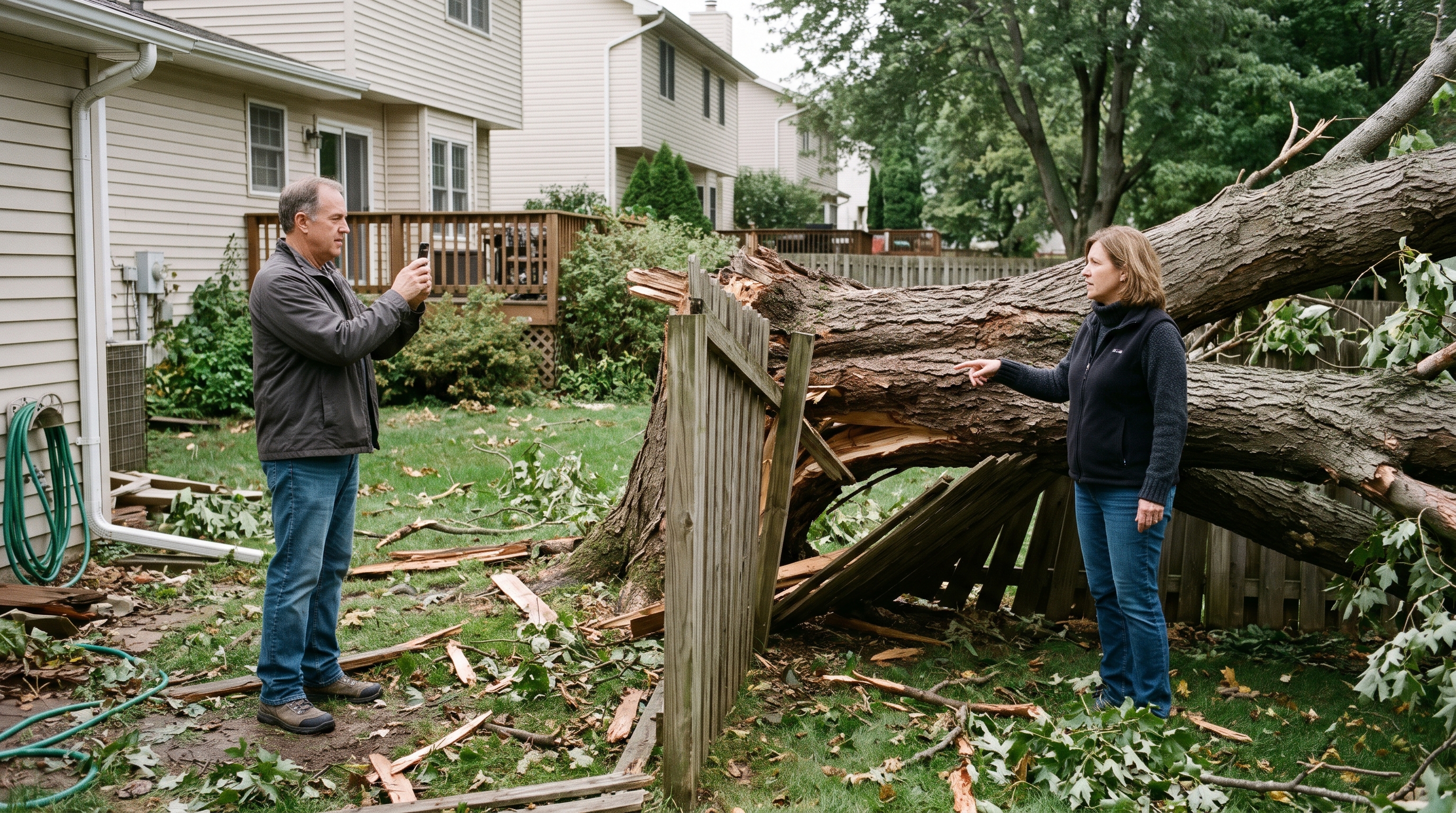
Waking up after a severe windstorm to find an eighty-foot oak lying across your backyard fence is stressful enough on its own. When that tree grew in your neighbor's yard, the immediate reaction is almost universal: call the neighbor, ask for their insurance information, and expect them to send a crew to clean up the mess.
In the vast majority of cases under United States property law, that is not how it works.
Property boundary disputes involving fallen trees are among the most misunderstood aspects of homeownership. The legal rules dictate who pays for the crane, who hires the chainsaw crew, and whose insurance policy covers the deductible.
Understanding the difference between an act of nature, a neglected hazard, and a municipal easement protects your wallet and keeps neighborhood relations from ending up in small claims court.
The golden rule of fallen trees: where it lands matters most
Under standard common law in nearly every state, responsibility for a fallen tree is determined by where the wood lands, not by where the trunk grew out of the ground.
If a healthy tree in your neighbor's yard is blown down by heavy winds, lightning, or an ice storm and crashes into your lawn, the event is classified legally as an act of God. Even though your neighbor owned the living tree yesterday, the debris that landed across your property line is your legal responsibility today.
You are responsible for hiring a tree service to cut up and haul away the portion of the tree resting on your property. Your neighbor is only responsible for the wood remaining on their side of the fence.
If the fallen tree damaged your roof, garage, or driveway, you must file a claim with your own homeowners insurance provider. Your insurer pays to repair your structures, minus your deductible, regardless of whose yard the tree originated from.
The critical exception: proving owner negligence
There is one major legal exception to the rule above, and it hinges entirely on negligence.
If a tree was dead, visibly rotting, hollowed out by termites, or structurally unstable before the storm hit, the owner has a legal duty of care to address that hazard. When an owner ignores a dead tree and a storm finally brings it down, the collapse is no longer an unforeseen act of nature. It is legal negligence.
In cases of clear negligence, the owner of the diseased tree can be held financially liable for all property repairs and debris removal costs incurred by the neighbor.
However, insurance adjusters and courts require solid evidence to prove negligence:
You must prove that the property owner knew, or reasonably should have known, that the tree was dangerously decayed.
The most effective evidence is prior written notice. If you sent your neighbor a polite letter via certified mail six months earlier expressing concern about large dead limbs hanging over your roof, accompanied by photographs or an inspection report from a certified arborist, you have clear proof of notice.
If you have documented that paper trail, your homeowners insurance company will pay for your immediate repairs and then pursue the neighbor's insurer through a legal process called subrogation to recover the costs, including your deductible.
If there is no prior documentation, proving negligence after the fact is difficult. A tree can look healthy on the outside with green leaves while holding severe heart rot deep within the trunk. Without prior warnings or obvious exterior signs of decay, insurance adjusters almost always treat storm falls as acts of God.
Trees growing directly on property lines
A boundary tree, sometimes referred to as a line tree, is a tree whose trunk crosses the boundary line separating two private lots.
Under property statutes in most jurisdictions, boundary trees are legally considered common property, owned jointly by both neighbors as tenants in common.
Because ownership is shared, neither neighbor has the legal right to cut down, top, or severely prune a boundary tree without the mutual consent of the other owner.
If a boundary tree falls during a storm, the cleanup costs are shared equally between both property owners. Each neighbor is responsible for clearing the debris on their side of the line, and if the tree crushed a shared boundary fence, both owners typically split the cost of replacing the fence panels.
If you suspect a tree along your property line is dying and you cannot reach an agreement with your neighbor on removal, hiring a professional land surveyor to mark the exact boundary pins is the first step, followed by a formal arborist risk evaluation.
When a tree falls on public streets or city property
Municipal rules come into play when fallen trees intersect with public sidewalks, streets, power lines, or city easements.
If a tree growing in a city-owned park, public easement, or street boulevard falls onto your private property, the municipal public works department or urban forestry team is typically responsible for removing the portion blocking public access. However, many cities will only clear the portion that obstructs the street or sidewalk, leaving the limbs on your private grass for your own homeowners insurance to handle.
If a tree growing on your private property falls outward into the street or blocks a public sidewalk, the city road crew will usually respond immediately with chainsaws to clear the travel lanes. In most municipalities, the city will bill the property owner for the emergency equipment and crew hours required to open the street, especially if the tree was dead or presented a known hazard prior to falling.
What homeowners insurance covers and what it leaves out
Many homeowners assume that calling their insurance company will resolve the entire bill for clearing a fallen tree. Standard policies carry strict limitations on debris removal.
When insurance pays
Your policy will cover tree removal if the trunk or heavy branches strike an insured structure. An insured structure includes your primary home, an attached garage, a detached shed, a workshop, a gazebo, or a permanent perimeter fence.
Insurance will also cover removal if a fallen tree has not hit a building but completely blocks your primary driveway, preventing you from driving your vehicle off the property, or if it blocks a ramp built for handicap accessibility.
When insurance pays nothing
If a sixty-foot tree topples over during a storm and lands cleanly across your grass, flower beds, or garden patio without striking any covered building or blocking your driveway, homeowners insurance pays nothing. You must pay a private tree service out of pocket to cut and haul the timber.
Debris removal caps and auto coverage
Even when an insured structure is crushed, standard homeowners policies enforce a sub-limit on debris hauling, usually capped at $500 to $1,000 per fallen tree. If taking down the remaining hanging sections and hauling the timber requires a crane costing $2,500, you will likely pay the difference above your policy cap out of pocket.
If a fallen tree crushes a vehicle parked in your driveway, homeowners insurance does not cover the automobile. Vehicle damage is covered exclusively under the comprehensive coverage section of your personal auto insurance policy, subject to your auto deductible.
For immediate steps on securing your roof, documenting tree damage for adjusters, and working with emergency crane operators, you can consult our emergency tree removal guide.
Municipal permits for fallen and storm-damaged trees
Before firing up chainsaws or hauling away a downed trunk, property owners need to understand local tree preservation ordinances.
In many cities and suburban townships, cutting down mature trees requires a municipal tree removal permit. These ordinances are designed to protect the urban tree canopy, especially for heritage species such as mature white oaks, redwoods, or historic hardwoods.
Failing to secure a permit before removing a tree can trigger municipal citations and code violation fines running from several hundred to several thousand dollars per tree.
Emergency permit exemptions
When a storm topples a tree across a roof, driveway, or power line, cities do not expect homeowners to wait weeks for a routine permit board review.
Nearly all municipal tree ordinances include an emergency hazard exemption. This exemption allows property owners and licensed tree contractors to immediately dismantle and remove any tree that presents an imminent threat to human life, structural integrity, or public safety.
To stay compliant under an emergency exemption:
Take clear, timestamped photographs from multiple angles before moving or cutting any wood. Document where the trunk fractured, how branches impacted structures or wires, and any visible interior rot or split roots.
Keep a written copy of the tree contractor's invoice detailing the emergency conditions that required immediate removal.
Contact your local city arborist or building department within twenty-four to seventy-two hours following the removal to file a retroactive emergency notification. Many municipalities simply ask for a brief form and your photographs to close out the record without charging a permit fee.
Dealing with standing, partially damaged trees
If a tree did not fall completely but suffered a fractured trunk, snapped crown, or lifted root plate during a storm, the situation is different.
Because the tree is still standing, city inspectors may not consider it an immediate catastrophe. Before taking down a partially damaged mature tree on your property, call the local planning or urban forestry desk. In most jurisdictions, having a certified arborist submit a short tree risk assessment detailing why the tree cannot be saved will secure an expedited permit approval within forty-eight hours.
Resolving tree issues before they fall
Waiting for a storm to decide who pays for tree removal is the most expensive way to handle property maintenance. Once a tree lands on a house or fence, deductibles, debris hauling fees, and neighbor tensions multiply rapidly.
If a tree on or near your boundary line looks suspicious, walk the perimeter with your neighbor. Most conflicts can be avoided by agreeing to split the cost of having an insured tree service prune dangerous overhanging limbs before bad weather hits.
If you need a professional assessment of a leaning or damaged tree, you can locate verified, insured arborists and crane operators in your area through the TreeRemovalNear.com directory.
Need a Verified Tree Removal Pro in Your City?
Avoid contract delays and unexpected pricing. Search our nationwide directory of licensed, highly-rated tree cutting and stump specialists with verified customer reviews.
Find Contractors Near You →